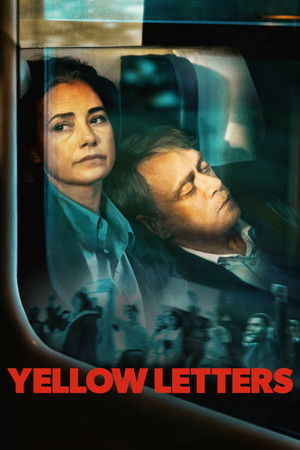
It might have seemed surprising, but shouldn’t have been, given the Berlinale’s tradition of giving out awards not solely as artistic recognition but also as political signals: The Golden Bear for Best Picture didn’t go to Beth de Araújo’s masterful Sundance success Josephine—an autobiographically inspired drama about an 8-year-old girl witnessing a rape—but to İlker Çatak‘s meta-textually charged relationship study Yellow Letters. It’s on many levels a story about the intersection of the private, artistic, and political. It’s a story about artists facing rigorous state censorship for their critical work and social media statements, the choice of which, among several strong competition contenders, seemed a little bit like damage control.
Accusations of censorship accompanied the last ten days, after which festival director Tricia Tuttle said, somewhat relieved, at the awards ceremony: “We’ve made it.” Politics and the question of to what degree they should intertwine with films were the main subject of the 76th Berlinale from the moment Wim Wenders (Perfect Days) made his infamous comments. “We are the counterweight to politics,” the jury president said at the opening press conference, adding, “No film has ever changed a politician’s ideas,” and “We should do people’s work, not politicians’ work.” It’s a bizarre view of cinema—one that led Indian author and activist Arundhati Roy to drop out of the festival in protest.
Wenders’ words are at odds with the time, parts of his own work, and, most of all, the Berlinale’s self-cultivated image as a politically conscious film festival. Thus, Tricia Tuttle found herself in the unenviable position of feeling the need to defend Wenders while simultaneously maintaining this image. That happened in the form of an open letter almost as loaded as the statements it appeared to defend. “Free speech is happening at the Berlinale,” it started out, but then went on to lament how filmmakers would be criticized if they answered political questions, and also if they remained silent. Never mind the many occasions on which filmmakers were applauded for political statements.
And never mind the occasions on which they spoke out on their own. Like Palestinian-Syrian director Abdallah Al-Khatib, who won Best Debut Feature for Chronicles from the Siege at Perspectives. Bringing a Palestinian flag to the stage at the awards ceremony, Alkhatib became one of several artists speaking out in support of Palestine, and added: “We will remember who stood with us and who stood against us, and who remained silent.” Silence, however, seemed to be expected from the press, to whom the open letter appears to be directed. “Appears,” as there is no mention of the press who, after all, are usually asking the questions at press conferences, the red carpet, and in interviews.
Press people were also poignantly excluded from the many acknowledgments that went out from the festival to the artists, audience, staff, and just about everyone else. The open letter raised the question of whether “we” would amplify enough the voices of filmmakers who experienced genocide, prison, exile, and many forms of mostly systemic and political repression. However, it never explained how this should happen without addressing political issues. “Artists should not be expected to comment on all broader debates about a festival’s previous or current practices over which they have no control. Nor should they be expected to speak on every political issue raised to them unless they want to,” the letter read.
Which sounds curiously like: You can ask and say what you like - but better not do it. One such unwanted question would be about the other open letter, signed by over 100 artists and published in Variety, that condemned the Berlinale for its alleged censorious stand toward artists opposing Israel’s genocide against Palestinians in Gaza and the German state's support of Israel. This conflict hung heavy over a festival edition that clearly raised both star power and cinematic quality, but only feels partially equipped for the heightened media scrutiny it invites. At the awards ceremony, host Desirée Nosbusch seemed visibly overwhelmed by the politically tense atmosphere which Tuttle addressed earlier that evening.
“If this Berlinale has been emotionally charged, that is not a failure. It is the Berlinale doing its job and its cinema doing its job.” So all the political questions that shouldn’t be asked, and debates that arose from them, are suddenly the merit of the festival? One thing, however, did ring true: “The filmmakers inspire us to demand more and to expect more and you ask quietly and loudly for us to see.” No matter if audience, film fans, or professional film journalists, one should demand more. More room for free arguments, more accountability, more inclusion and equality in a festival still strongly shaped by hierarchies, status, and economic ability.
And as for the 276 films from 80 countries, look for our many reviews and interviews.
All the award recipients are listed here.

 Bildnachweis: © Berlinale 2026