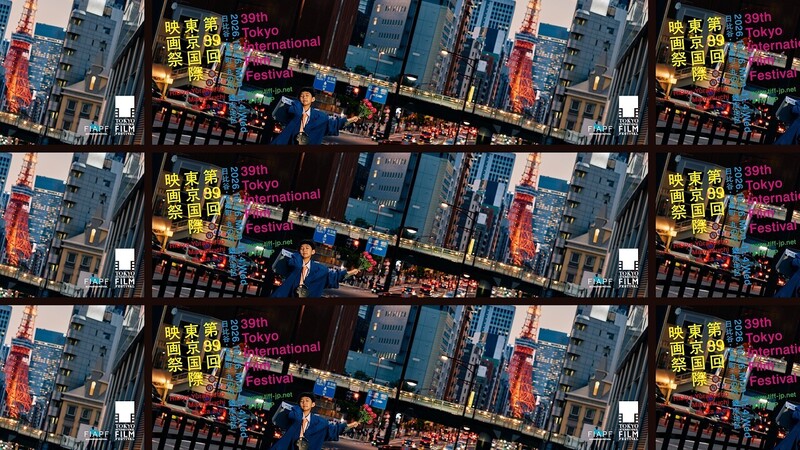
While its big anniversary is still a year ahead, the Tokyo International Film Festival seems already in a celebratory mood, despite mixed prospects regarding revenue and not being unaffected by the global festival sphere’s struggles. These variable forecasts found their meteorological metaphor in constant rain showers, which couldn’t impress the audience crowding at the red carpet of yesterday’s opening ceremony. Nor could they spoil the good spirits of the umbrella-protected talent and prominent personalities on their way to the gala in the heart of Ginza where the festival's main venues are located. Times of uncertainty can’t intimidate the cinephile crowd, seemed the soaked star event’s overall message; one that was also reflected in the choice of the opening film.
Takahisa Zeze’s Sukiyaki Ue o Muite Arukô, as the Japanese title reads in full, tells the story of the 1963 hit song that would rise to the no. 1 position of the US Billboard charts. This success, unmatched by any other Asian song, could illustrate the festival's aspiration for the top tier among Asian film festivals. Since its emergence in 1996, this position has been held by Busan, which just closed a week ago, with Hong Kong and Shanghai racing for the second spot. The fact that Tokyo, together with Busan and Shanghai, is newly inaugurated in the FIAPF (Fédération Internationale des Associations de Producteurs de Films), levels former distinctions in official prestige and structural status.
Asian A-Listers
After a drop in the early 2020s, audience numbers are recovering, as the number of films and representative premieres keeps growing. Running from 25th October until 4th November, the 39th edition includes 204 films from 112 countries and regions in its programme with a confident focus on Asian auteurs and audience favorites. Newly appointed festival director Takeo Hisamatsu seemingly reads this edition’s theme of “CONNECTING — Cinema Connects Us to the World Beyond” (sounds a bit like death at the movies, which for overworked and underpaid film press is certainly a realistic scenario) as a commercially beneficial bridge between European and Asian productions. “Introducing international films to the audience in Japan is an important mission of the festival.”
At the same time, he hopes to put “more weight on using the festival to introduce Japanese films to the international audience.” Titles like Godzilla Minus One, whose sequel Godzilla Minus Zero screens as the centerpiece, or Ryusuke Hamaguchi’s Cannes competition entry Sudain, starring Tao Okamoto beside Virginie Efira, underline this goal to which new discoveries become secondary. Less than half of the 15 competition films are world premieres. Among them, Qiu Jiongjiong’s Fuxi: Four Tales of Feasting promises a surreal time travel, staged entirely within a hand-painted studio. Akira Ikeda’sThe Canary’s Lullaby fantasizes about an elderly woman and a mysterious creature, and after a successful festival run, Teodora Ana Mihai’s Heysel 85 arrives on Asian screens.
Patriarchal Structures Stifle Parity
Jelena Maksimović’s Until the Day Ends dives into Serbia’s student demonstrations, while The Difficult Bride by Rubaiyat Hossain evokes spectral powers in a Bangladeshi beauty parlour. Japanese cinema receives additional attention through the newly competitive Nippon Cinema Now section. Among its eight titles is Earthlings In Love, from One Cut of the Dead director Shinichiro Ueda, based on the vertical-video series. Cate Blanchett will attend screenings of five short films supported by the Displacement Film Fund, which she co-founded, alongside Iranian director Mohammad Rasoulof and Afghan filmmaker Shahrbanoo Sadat. However, their presence can’t hide the severe lack of representation within this distinctly patriarchal festival institution. Women direct a measly 47 of the over 200 films.
Less than a quarter, but still much more than Black filmmakers and the once again non-existent authentic artist voices from the underclass. Using the theme of social inequality and class struggle to satisfy one's own middle-class intellectualism isn’t the same as actually including the people affected by them. The bourgeois eclecticism of the likes of Ulrike Ottinger and Angela Schanelec, part of TIFF JP’s World Cinema slate, has hardly anything to do with an improvement in diversity and parity. As Tokyo enters a new chapter, the question is not only if this will boost industry opportunities, but who will get the chance to use them.

 Bildnachweis: © TIFF JP 2026